Essay
The Late Student Who Feels Like a Genius for Believing in Mystics
Or how I tried to justify my cat with Newton
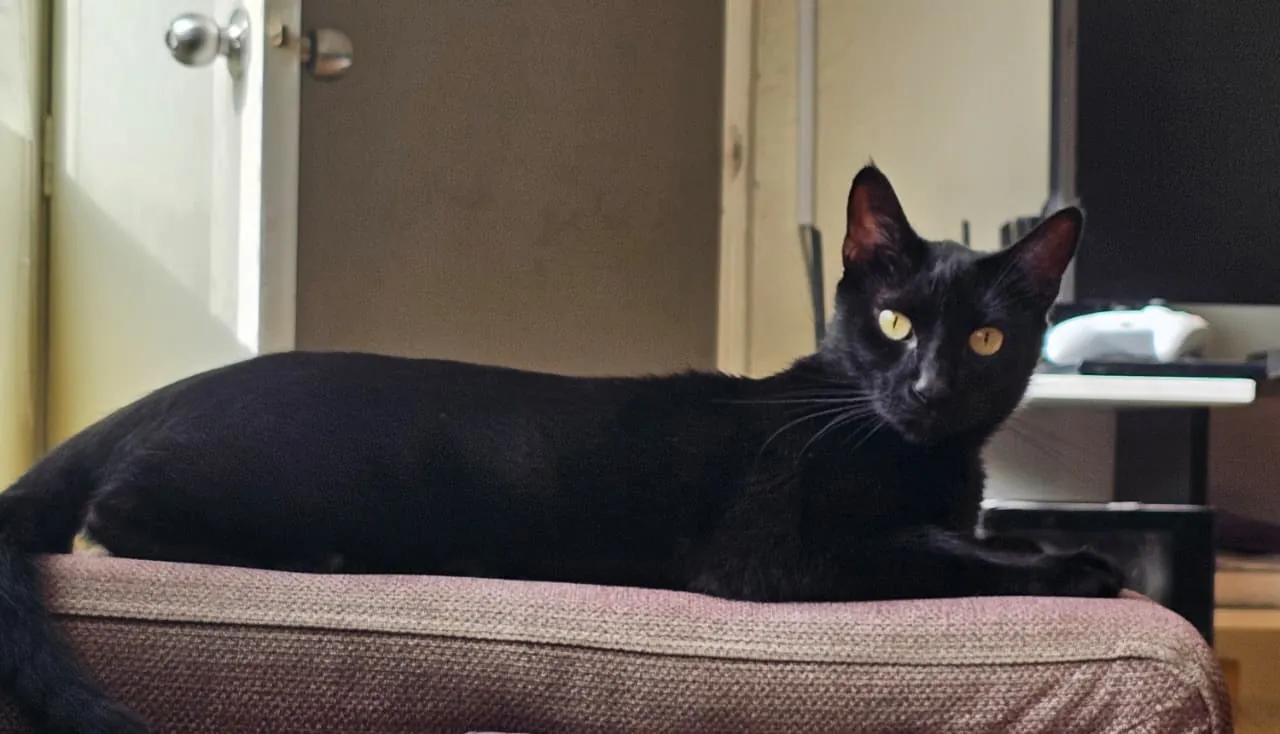
My black cat disappears. Not every day, but he disappears. He's gone for hours and comes back as if nothing happened, climbs onto the armchair, licks a paw and gives me the look of someone who has just left an important meeting. I have my theory: he goes off to do his patrol in hell. And it's not just the colour. Once, when he came back, I caught a smell of something burnt on him. If anyone has the scientific explanation, let me know. Seriously. I couldn't find it.
While we're at it, I'll confess more. I believe in poltergeists. I haven't had my cards read in a long time, because my faith forbids it; a curious God, mine, who bans tarot but lets me live with ghosts that move things around. And every now and then I invoke my supreme right to believe in destiny.
So far, nothing strange. Plenty of people believe in something like this; I'm not original. The strange part is that I study psychology, I write about checking sources, and I have an entire line of research on how people use authority so they don't have to check what they say. I owed myself a justification. And like a good student I did what I know how to do: I went looking for authorities.
I started at home
I'm a Jungian. One of the good ones, I think, the kind who read more than the collective-unconscious quote on Instagram. So I started with Jung, who for this sort of thing is a feast.
In 1909 Jung visited Freud in Vienna and they argued about the paranormal. Freud, the rational one, dismissed all of it. In the middle of the argument Jung felt a strange heat in his diaphragm, and at that moment there was a loud report in Freud's bookcase. Jung told him it was "a so-called catalytic exteriorization phenomenon" and, to top it off, predicted there would be another. There was. Freud just stared at him, like someone watching his favourite student lose his mind. For me it's the best scene in the history of psychology: the mystic disciple scores a point against the master with help from a piece of furniture.
And it wasn't the first time. Years earlier, in his mother's house, a walnut table split by itself and a knife turned up broken into pieces in the bread basket of the sideboard. His doctoral thesis, in case there were any doubts, was on occult phenomena: he studied the séances of a cousin who acted as a medium.
We know almost all of this because Jung himself told it in his memoirs. My source is the protagonist himself. What more do you want?
Then came Peterson
Later I read Jordan Peterson, the Peterson of his impeccable period, the one of Maps of Meaning. That's where I fell in love with religious iconography: dragons, heroes, chaos and order as maps the mind uses so it doesn't get lost. My reading, and I mark it as mine, was roughly this: if myths are maps, my superstitions aren't oddities. They're archetypes on a tight budget.
So I did the logical thing. I enrolled in psychology convinced that my strange beliefs had a place in the curriculum. That somewhere in some course there was a drawer to file the cat in.
The ladder of geniuses
But psychologists, as everyone knows, get looked at sideways. I needed something harder. Physics, mathematics, people with equations. And I found it.
Wolfgang Pauli, Nobel laureate in physics, worked with Jung on synchronicity, those coincidences that make sense and have no cause. His colleagues swore, too, that lab equipment broke down when he walked in; they called it the Pauli effect. A Nobel laureate with his own poltergeist. I no longer felt so alone.
Kepler, the orbits man, cast horoscopes on commission. He is credited with saying that astrology was the foolish daughter who kept her wise mother, astronomy, fed. In other words, the cards paid for the science. That seemed very reasonable to me.
Edison, the light-bulb man, said in an interview that he was working on a device to talk to the dead. I don't know if he finished it; years later he said it had been a joke. My cat might know.
Niels Bohr, the story goes, had a horseshoe hanging over his door. Someone asked him if he believed in it, and he said no, but that he'd been told it works even if you don't believe. I'm keeping that one for when people ask me about the cat.
And above them all, Newton. The man of gravity spent years on alchemy and on calculating biblical prophecies, in the same period he was writing the Principia. Keynes, who bought his manuscripts, called him "the last of the magicians".
There was my defence, complete and with a bibliography. If Newton could, so could I. If a Nobel laureate had his ghost, I could have my cat. And as a bonus, William James, the father of American psychology, wrote in 1896 that in certain cases, when the evidence isn't enough to decide, we have the right to believe. Permission granted.
And then Popper showed up
The funny part was that, in the middle of my hunt for evidence, I ran into my worst enemy, who is also my best friend. Karl Popper. The one who taught me the most valuable thing I have as a student: that what I say, what I produce and what I want to study has to be able to fail. If nothing can show that I'm wrong, it isn't science. And he taught me what hurts most: if you're always right, you're very probably never right.
And what I was doing had a name. I know it by heart, because it's what I research. I was appealing to authority: piling up geniuses so I wouldn't have to check anything. Newton did alchemy, yes, but gravity isn't true because Newton was a genius. It's true because it can be measured. His alchemy never worked. And there's also the list of those who looked to the sky and never came back: Nobel laureates like Linus Pauling, with his megadoses of vitamin C, or Luc Montagnier, with his DNA that emitted radio waves, who ended up defending things that didn't survive the first test. Genius is no vaccine.
Bertrand Russell, who taught me to write clearly, finished me off. He invented the teapot: if I say there's a teapot orbiting the Sun, too small to be seen with any telescope, it isn't anyone else's job to prove it doesn't exist. It's my job to prove it does. My cat and his burnt smell are, technically, a teapot.
But Popper, my enemy, left me a door ajar. He never said that what can't be refuted is meaningless. He said it isn't science, that it's something else, and he even acknowledged that some metaphysical ideas had inspired real science. The cat isn't science. Popper never said it doesn't exist.
What none of them took from me
Here comes the only serious part of this text. No scientist forced me to stop feeling. None of them asked me to stop believing in what, at the very least, makes me curious. Popper demanded rigour for what I claim, and Russell, clarity in how I say it. None of them got involved in what I feel when the cat comes back.
And in the middle of séances with Claude (yes, the AI) I learned what really matters: you don't need to stop being who you are, or stop believing, to be rigorous. So if you see me running around stark naked, smelling of patchouli and reading people's futures, you know who to blame: Newton and co. Welcome to psychology.
Appendix: the right of reply
Since we give the right of reply here, and since I'm not yet an authorised voice (for the critics, an ill-starred one), I grant them the defence.
Even so, in my opinion as an unauthorised and ill-starred voice, I see it as a defence from the inside. And that I'm completely free to say.
Translated from the Spanish original.
Sources
- Blasco, J. M. (June 2018). Freud, Popper y el sentido común: la falsabilidad del psicoanálisis. Espacio Psicoanalítico de Barcelona. https://www.epbcn.com/textos/2018/06/freud-popper-y-el-sentido-comun/
- Jung, C. G. (n.d.). Memories, dreams, reflections (A. Jaffé, Ed.; R. Winston, & C. Winston, Trans.; rev. ed.). Vintage Books. (Original work published 1962) https://archive.org/details/MemoriesDreamsReflectionsCarlJung_201608
- MacTutor History of Mathematics. (n.d.). John Maynard Keynes: «Newton, the Man». https://mathshistory.st-andrews.ac.uk/Extras/Keynes_Newton/
- Quote Investigator. (2013, October 9). I understand it brings you luck, whether you believe in it or not. https://quoteinvestigator.com/2013/10/09/horseshoe-luck/
- Thornton, S. (2026). Karl Popper. In The Stanford Encyclopedia of Philosophy (revised 31 July 2026). https://plato.stanford.edu/entries/popper/
Reference works (English Wikipedia, 19 Nov 2026): Carl Jung, Memories, Dreams, Reflections, Synchronicity, Pauli effect, Johannes Kepler, Electronic voice phenomenon, Isaac Newton, The Will to Believe, Nobel disease, Russell's teapot, Maps of Meaning.
Every claim in this essay was read at its source on 19 November 2026; the verification file records the source, the original wording and how it was checked. What Jung tells about himself is his testimony, not a verified fact. The Kepler line and Bohr’s horseshoe are doubtful attributions, and the text says so. The cat is the author’s testimony.