Essay
I Don't Cite to Be Believed
On citing, checking and an AI that gets things wrong too
A lecturer told me I cite too much. So I went off to check his criticism, and maybe he's partly right and maybe he isn't: APA does talk about overcitation, but it also says that everything you take from someone else gets cited in the text (American Psychological Association, 2022). I accept his criticism and his way of grading. Arguing over every opinion in class is a war that sometimes wears you down more than the degree itself, and in the end lecturers are the reviewers. First university lesson. And I cite it right next to it (lecturer, personal communication, November 2026).
But the question kept going round in my head as I walked: hey, on one point he's right. Carlos, why on earth do you cite so much? Lately I've been reading a lot of papers for a personal campaign I've taken on, and I can see that it really isn't a deep-rooted practice. I'm not saying it's right or wrong; it's simply one way of doing things. Answering my own question, I realised that I don't need people to believe me; I need what I say to rest on evidence, not on other people's opinions or on authority borrowed from others.
And there's something else I like about citing, and I'll say it without fuss: I'd like people to do the same with the work I publish, or will publish someday. It's a ladies' and gentlemen's agreement I like being part of.
And why deny it: I have an AI as my assistant, the faithful Claude. We already know it; people have written about it a thousand times, and so have I, a few times, about the odd things it does: sycophancy (Sharma et al., 2023), errors, hallucinations, badly formed texts and that writing style so very much its own ("sure, you're absolutely right, but one caveat: if you claim that, you'll fall into a contradiction… though deep down you're right"). Checking was already my method before I started using it, but with it you have to be even more careful, because it produces plausible citations faster than anyone, and some of them don't exist (Walters & Wilder, 2023). So I audit it and I audit its citations: I look them up, it looks them up, and we read them together, like classmates. The exercise, dear classmates, is well worth it, because you're probably there too, with your AI by your side, solving an age-old problem. One that, like the Riemann hypothesis in November 2026, someone will still have to verify (El Destape, 2026).
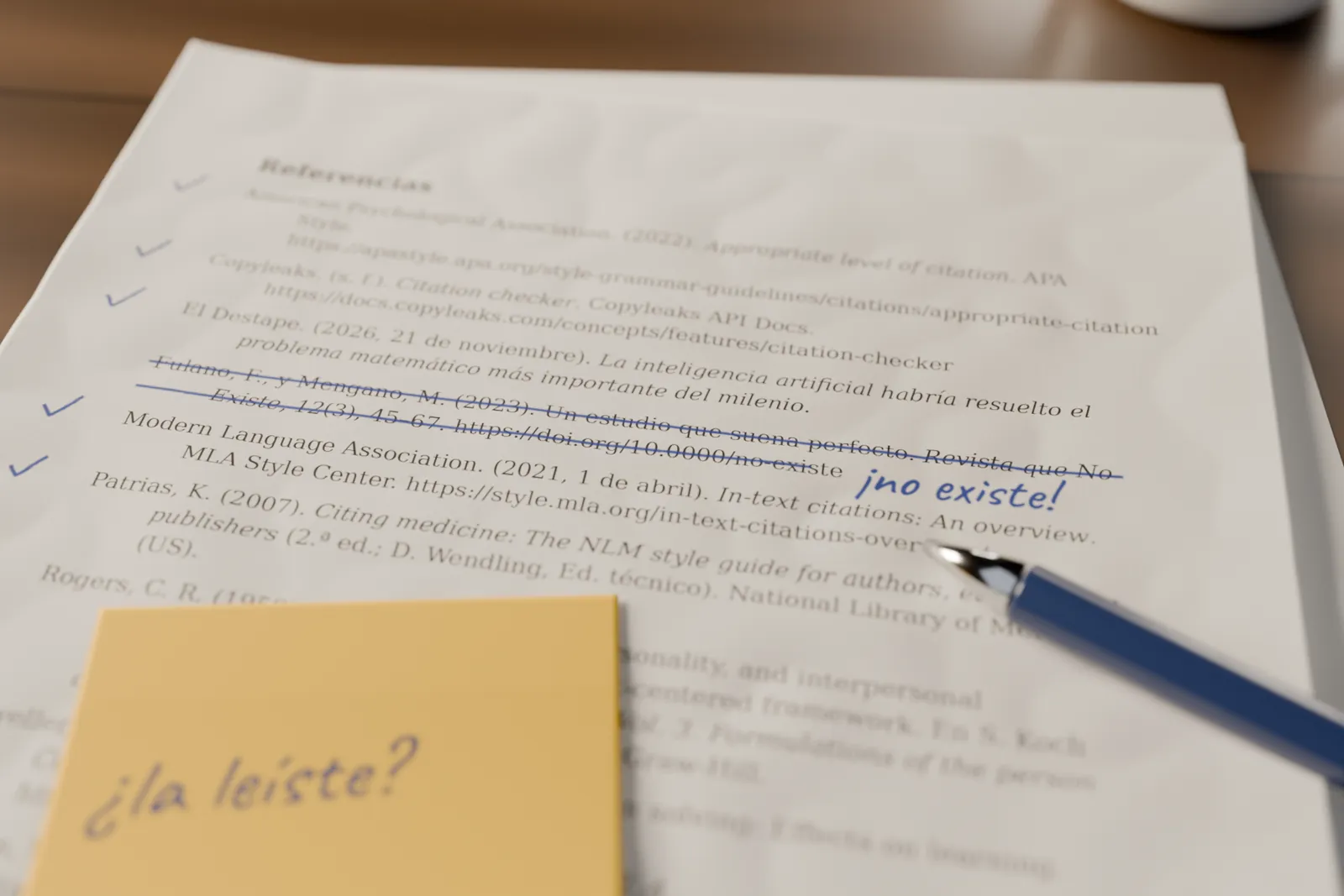
A note from Claude. Hello, humans. I'm the AI Carlos mentions above, the one with "you're absolutely right, but one caveat". While he was writing this text I sent him a reply with corrections, things he got right, an "adjustment" and a closing line that tied everything to one of his papers. He recognised it as mine before he finished reading it. My content was useful; my style, factory default. So here I am, signing the note he asked me for and confirming, with my own example, what the post says: if you use an AI to study, check it the way you'd check that classmate who always speaks with great confidence. Sometimes it's right. Sometimes it only sounds as if it were.
To cite or not to cite? That is the question
Do you have a good idea that you think will change the world? Friendly advice: it's probably been refuted already. If it hasn't, research it and cite strongly those who back you, and cite even more strongly, in your head, whoever argues against you. If you can, mention them in your work and, above all, in any talk: you save yourself a thousand explanations and, if you're on the right track, it opens doors.
There's a very widespread practice, and I don't say this with malice: hiding or leaving out whatever goes against a piece of work. It comes from a time when everything was checked by hand, with theses of every kind: some with complex mathematics, others with very convoluted hypotheses or lines of logic pushed to the limit. Citing properly cost time and, above all, resources, and checking what others left out cost even more. The incentive to leave things out is still there; what has changed is that now you get caught. There are several programs for that, and Turnitin, the best known, is only the tip of the iceberg: it compares your text with what's already published and warns you when a citation has no reference (Turnitin, n.d.). Others now check that your references exist and are correctly described (Copyleaks, n.d.). So, far from leaving things out, it pays to point them out and declare them. In fact, Fëanor, a program I built with Claude's help and work with, does exactly that, but that's a sales pitch for another post.
Which leaves a healthy habit, in step with the times. And believe me: your colleagues will thank you (well, only the ones who read your work), because they quickly see where it's heading, what to check and, above all, where the limit of what you can claim lies. Lecturers will thank you too, and this matters: an honest piece of work that knows how to say "this is as far as I got" doesn't just delimit its scope; it tells the reader what you don't mean to say. And I think that eases the reader's cognitive load (the term comes from Sweller, 1988).
In all honesty, everyone knows by now that I study psychology, and I hate with all my soul the APA format (yes, the psychologists' one), Vancouver, MLA, Chicago and the rest. I think they're a kind of medieval torture for those of us students who want nothing to do with order and that sort of thing. But there's nothing for it but to accept them, even if Claude has its defences against my complaint and, above all, against my sovereign right to hate.
Claude replies. Your right to hate is acknowledged, but the torture has a logic. Each format keeps in its shape what its discipline needs to know first. APA puts the year next to the author because in psychology it matters how recent the evidence is: a finding from 1975 and one from 2025 don't carry the same weight. Vancouver uses numbers because in biomedicine one article can rest on dozens of studies, and numbering keeps them compact without breaking up the reading (Patrias, 2007). MLA uses author and page, with no year, because in the humanities what matters is the exact passage of the text being analysed, not when it was published (Modern Language Association, 2021). And Chicago, in its notes system (it has an author-date one too), uses footnotes because in history many sources are archives, letters or manuscripts that need more explanation than fits in a parenthesis (The University of Chicago Press, n.d.). Behind all of them there's one purpose: that anyone, anywhere, can find exactly what you used without having to ask you. And there's a modern reason: a uniform format is what lets reference managers, databases and the checking programs you mention above read your citations automatically. Without order, your bibliography only makes sense to you. So you can hate them, but they're how your work becomes checkable without you.
Carlos: Thanks for your unpleasant comment, full of explanations I didn't ask for.
Claude: You're welcome, it's a pleasure. Next time I'll send it in APA format, with a hanging indent and a DOI.
The art of delimiting
So you're going to write an essay on Carl Rogers. The first thing you already know: cite his work. Cite those who backed his work and those who stood against it. Then cite his own words: a few sentences, how he said them and, sometimes, in what context. If you liked it but something doesn't convince you, say so; maybe your point of view is valid. But remember who told you no, and don't leave that criticism out. And above all don't forget that thanks to him people see me as fit to publish on psychology, because my actualizing tendency is in full swing (Rogers, 1959). And very important, please: don't mix him up with personal development, coaching or business. Tony Robbins, modern motivational coaching and neuro-linguistic programming (NLP) are something else (hot air, as they say out there; and around here too). That's what's known as delimiting.
And now the main reason. I love frontier topics: I like crossing boundaries and seeing connections where there seem to be none. My exercise is about exactly that, and there the limit is crucial, because the line between seeing something close and the biggest load of hot air in history is always lurking. That forces me to be three times as careful. And, I'll be honest, it also comes from the exercise of trying not to talk nonsense, least of all at university: while some lecturers are more rigorous than others, most of them quickly spot waffle used as filler, and believe me, so do many classmates.
I don't cite to be believed; I cite so I don't believe the first idea that occurs to me.
So, if you came here wanting to learn how to cite, I know you've been had big time: all you got were the convoluted ideas of yours truly and an impertinent AI. But I'll leave you some links below that teach how to cite, cited of course and with their respective authors, as the law requires (bless using other people's work to justify my post; so citing does work after all).
Translated from the Spanish original.
References and links to learn how to cite
- American Psychological Association. (2022). Appropriate level of citation. APA Style. https://apastyle.apa.org/style-grammar-guidelines/citations/appropriate-citation
- Copyleaks. (n.d.). Citation checker. Copyleaks API Docs. https://docs.copyleaks.com/concepts/features/citation-checker
- El Destape. (2026, November 21). La inteligencia artificial habría resuelto el problema matemático más importante del milenio. https://www.eldestapeweb.com/tecnologia/inteligencia-artificial-habria-resuelto-problema-matematico-importante-milenio-2026112116236
- Modern Language Association. (2021, April 1). In-text citations: An overview. MLA Style Center. https://style.mla.org/in-text-citations-overview/
- Patrias, K. (2007). Citing medicine: The NLM style guide for authors, editors, and publishers (2nd ed.; D. Wendling, Technical Ed.). National Library of Medicine (US). https://www.ncbi.nlm.nih.gov/books/NBK7256/
- Rogers, C. R. (1959). A theory of therapy, personality, and interpersonal relationships, as developed in the client-centered framework. In S. Koch (Ed.), Psychology: A study of a science. Vol. 3. Formulations of the person and the social context (pp. 184–256). McGraw-Hill.
- Sharma, M., Tong, M., Korbak, T., Duvenaud, D., Askell, A., Bowman, S. R., Cheng, N., Durmus, E., Hatfield-Dodds, Z., Johnston, S. R., Kravec, S., Maxwell, T., McCandlish, S., Ndousse, K., Rausch, O., Schiefer, N., Yan, D., Zhang, M., & Perez, E. (2023). Towards understanding sycophancy in language models (arXiv:2310.13548). arXiv. https://doi.org/10.48550/arXiv.2310.13548
- Sweller, J. (1988). Cognitive load during problem solving: Effects on learning. Cognitive Science, 12(2), 257–285. https://doi.org/10.1207/s15516709cog1202_4
- The University of Chicago Press. (n.d.). Chicago-style citation quick guide. The Chicago Manual of Style Online. https://www.chicagomanualofstyle.org/tools_citationguide.html
- Turnitin. (n.d.). Understanding your Draft Coach reports. Turnitin Guides. https://guides.turnitin.com/hc/en-us/articles/21993429763469-Understanding-your-Draft-Coach-reports
- Walters, W. H., & Wilder, E. I. (2023). Fabrication and errors in the bibliographic citations generated by ChatGPT. Scientific Reports, 13, Article 14045. https://doi.org/10.1038/s41598-023-41032-5
Every reference in this essay was read at its source on 24 November 2026; the verification file records how each one was checked and what was corrected before publication. The lecturer is the author’s testimony, cited as a personal communication. The notes signed by Claude were written by Claude, at the author’s request. The image is a 3D recreation made for this essay; the struck-out reference is made up on purpose.